
Inertial Awareness
Accurate system inertia data is becoming crucial for power system operations

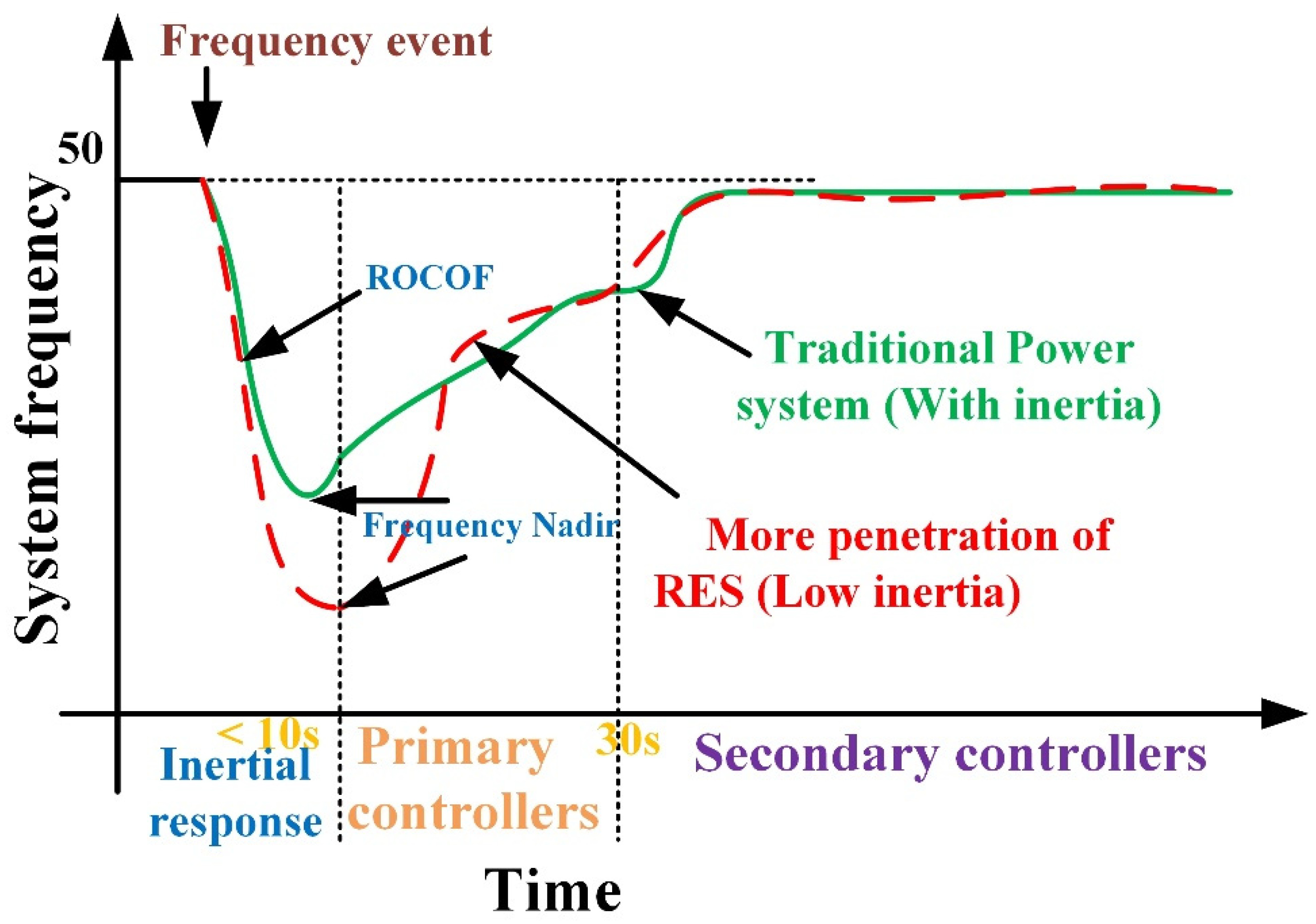
As power systems around the world transition to increasing levels of renewable energy resources, grid operators are struggling with the changing physical characteristics of the power system that accompany this shift from traditional synchronous generating resources (SGR - coal, natural gas, hydro, and nuclear generation) to inverter-based resources (IBR - wind, solar, and batteries). Two of the biggest operational impacts of this change in the resource mix are declining power system inertia and voltage support, both of which are naturally provided by SGR. The reason for this is that SGR are directly electrically coupled to the power system through the electric fields of their generator windings while IBR are connected to the power system indirectly through sophisticated power electronics. I’ve written explanations of system inertia and reactive power in previous articles for those interested in learning more.
Because of these changes in system characteristics, power system operators must now pay much more attention to real time system inertia and voltage levels than they had to in the past to ensure there are adequate SGR available to keep the system stable when a disturbance happens that upsets the supply demand balance or when there are localized voltage issues due to large volumes of IBR providing energy in specific areas.
I think two recent studies do a good job of illustrating these operational challenges.
WECC Changes in System Inertia Study
In 2021, the Western Electricity Coordination Council (WECC) completed a study of the reliability impacts of increasing levels of IBR operating across the Western Interconnection. The Changes in System Inertia Study demonstrates the increasing operational risks IBR are creating for system operators across the Western Interconnection and makes 6 recommendations as follows:
Planning Coordinators, Transmission Planners, Balancing Authorities, and Reliability Coordinators should monitor system inertia and frequency response, especially under low inertia conditions.
The System Review Subcommittee (SRS) should track the amount of inertia and report frequency response under a large generation contingency in each of the Western Interconnection base cases. Additionally, SRS should consider developing a minimum system inertia case on an ongoing basis so that entities can evaluate for adequate system frequency response under low inertia conditions.
Planning Coordinators, through their participation in the under-frequency load shedding (UFLS) Work Group, should investigate islanding scenarios and evaluate the UFLS plan to make sure the set points of the UFLS relays are still adequate due to the drastic change in the rate of change of frequency (ROCOF) caused by increased penetration of IBRs. The UFLS Work Group assessments should include minimum inertia cases to ensure the adequacy of the UFLS plan.
Planning Coordinators, Transmission Planners, and Reliability Coordinators should perform additional studies to better understand the impact of reduction in synchronous resources on transient and voltage stability in the Western Interconnection. These studies need to evaluate the implications of shifts in generator locations.
The WECC Modeling Validation Subcommittee (MVS) should ensure dynamic models provide a reasonably accurate representation of IBR frequency response that represents capabilities of wind and solar resources. The MVS should develop a guideline on frequency response modeling of various IBRs.
Transmission Planners should ensure that Generator Owners include frequency response characteristics and provide validated models.
This study demonstrates the significant operational challenges the shift to IBR from SGR is creating across the Western Interconnection, and is recommended reading for all WECC participants.
Alberta Electric System Operator (AESO) Reliability Requirements Roadmap
In March 2023, the AESO published the Reliability Requirements Roadmap to address the Alberta power system operational impacts of increasing levels of transmission connected IBR, distribution connected IBR, and changes to demand patterns due to increasing electrification. The report provides an excellent overview of the challenges facing Alberta’s evolving power system and highlights the fact that “While this shift creates investment opportunities and helps the province to progress towards a decarbonized electricity system and economy, it also presents significant operational challenges.” The report focuses on 3 key areas of system reliability:
Frequency Stability - this is the ability of the power system to maintain sufficient frequency and recover to normal operating frequency (60 Hz) following the sudden loss of a large supply source. The AESO considers Frequency Stability to be their highest priority, stating “Existing frequency-related operational challenges mean that immediate action is required to reduce frequency stability risk. The need for mitigation will continue to grow over time as the generation fleet continues to transform.” Essentially, the AESO is saying that as more IBR are added to the system without the addition of SGR, the harder it will be to maintain adequate frequency control.
System Strength - this is the ability of the power system to maintain normal voltage at any given location despite system disturbances. The AESO sees System Strength as a localized challenge in specific areas of the system in the near term but increasing in significance if not addressed soon.
Flexibility Capability - this is the ability of the power system to adapt to dynamic and changing conditions while maintaining the balance between supply and demand. This is manageable today but will become more challenging as more IBR are added.
As with the WECC study, the AESO study demonstrates the increasing operational challenges associated with increasing levels of IBR on the Alberta power system.
Game Changer - Direct Measurement of System Inertia
Given these operational challenges, the importance of understanding system inertia and system strength levels in real time is critically important for system operators. Currently, system operators calculate the inertia of their power systems using system models to maintain situational awareness. While models are useful, they are only estimates and require system operators to allow large operating margins which results in inefficient system utilization and operational uncertainty.
However, an exciting new technology from a company called Reactive Technologies could be a game changer. Reactive Technologies has developed a system that gives power system operators a way to directly and accurately measure power system inertia and system strength in real time, as opposed to using mathematical estimates. This improves situational awareness and enables far more effective and reliable power system operations.
The technology works by injecting energy pulses into the power system using an “ultracapacitor” and analyzing the return signal time and waveform to calculate inertia and system strength. This enables direct measurement of system inertia that is far more accurate than model estimates so system operators know the actual inertia of the system in real time. National Grid in the UK and TEPCO in Japan are already using this technology. Here's a quote from the reactive technologies website:
"Reactive Technologies’ Grid-Sonar ™ technology measures grid response through a periodic pulse of energy that is pushed into the system via a custom-built modulator. The signal that comes back provides real-time grid insights with unprecedented accuracy, allowing grid operators to monitor inertia and system strength levels and stay prepared should a disturbance arise... Once the noise has been filtered out, the minute changes in frequency and voltage can be observed across the entire grid. The behavior of these frequency movements is a measure of the grid’s inertia, while the voltage movements measure the grid’s system strength."
This is game changing technology for system operators as we move into an IBR dominated future, so I hope to see it widely adopted in the near future.
For those interested in learning more, here’s a link a CIGRE symposium white paper on the technology: Inertia Estimation Methodologies vs Measurement Methodology: Impact on System Operations
I am guessing you are not buying the whole battery based synthetic inertia being pushed right now?
So, I guess that’s why Manitoba Hydro’s Brandon thermal generation facility now runs most of the year as a synchronous condenser which regulates their grid’s voltage in southwest Manitoba… to increase the grid “inertia” - correct?
Renewables typically supply power to the grid via inverters, same with batteries, aka inverter based resources (IRBs)…
Perhaps Alberta should mandate smart inverters going forward?
https://dynapower.com/resource/advanced-smart-inverters/
Apparently there is a “working group” for that 🤠👍🏼
https://gridworks.org/wp-content/uploads/2024/02/Smart-Inverter-Operationalization-Working-Group-Report-Feb.1.24.pdf